B2B Marketing Strategy · February 2026 · 12 min read
The Dumbest B2B Marketing Advice on the Internet
Because most "best practice" is built for Slack and HubSpot. Not for a small manufacturing firm in Sheffield who sells to a very select type of person at a very select type of company.
You know what really pisses me off about B2B marketing?
Almost everything you read online is based on massive companies with massive budgets. We're talking Slack. HubSpot. Salesforce. Companies with a marketing team bigger than your entire headcount.
And the rest? Outdated "tips" from B2C advertising that don't even slightly apply to a 15-person engineering firm in the Midlands who sells racking systems to a very specific type of buyer at a very specific type of company.
Yet somehow, this is the advice being nailed down people's throats. By marketing gurus. By consultants who've never worked with a company under £50m. And yes, even by the ad platforms themselves. "Build a brand community." "Go broad and let the algorithm learn." "Focus on top-of-funnel awareness."
Mate. You've had to fight with the managing director for this budget. They're breathing down your neck asking where the leads are. You don't have time for a 9-month "awareness journey."
So here are six pieces of marketing advice that sound smart, feel safe, and quietly destroy small B2B companies. I'm not anti-marketing. I love marketing. I do it for a living. I'm anti watching good companies waste money on strategies that were never built for them.
I run paid ads for small niche B2B companies. That's it. That's the whole business. Not enterprise SaaS. Not consumer brands. Companies with 5 to 50 employees selling specialist products and services to a very specific type of buyer.
I've audited over 100 LinkedIn ad accounts and managed north of £2M in B2B ad spend. Almost every single one was following at least two of the myths below.
Video Chapters
Myth 1: "Build Brand First. Sales Later."
This one makes me physically uncomfortable.
"Build brand first. Revenue will follow." Beautiful advice. Genuinely. If you are Coca-Cola.
Coca-Cola can run brand awareness campaigns for six months and not blink. They've got shareholders who understand the long game. They've got decades of brand equity already in the bank. You? You are a £3 million revenue compliance software company with 11 employees and a founder who checks the bank balance every Monday morning.
Brand doesn't mean as much as you think it does at this stage. Stop spending time on it and get more customers in the door. Sorry to all the brand consultants out there. But for small businesses, brand first basically means you're a glorified graphic designer. And a very expensive one.
And here's the thing that really kills me: founders spend ages deliberating over how the brand looks. The logo. The colours. The tone of voice document. You don't get to decide that. It's not up to you how the brand feels. It's up to your customers. They'll decide that based on the work you do.
Here's what actually happens when small B2B companies follow this advice: they set up a LinkedIn campaign with a brand awareness objective. £1,500 a month. Three months. Thousands of impressions. Zero leads. Then someone in a board meeting says "ads don't work for us" and the budget gets cut.
That's not a failure of ads. That's a failure of choosing the wrong objective for your situation.
I've seen this exact scenario play out in dozens of accounts I've audited. Same story. Different company name.
"If your marketing strategy requires you to wait 9 months before revenue improves... that's not strategy. That's hope. And hope is not a line item."
What to do instead
Skip the awareness objective. Use website conversions from day one.
Make your first ad a direct-response piece. A case study. A specific result. Something that proves you solve the problem they actually have.
Brand is a byproduct of doing good work and growing your business the proper way. It gets built as a side effect of being relevant and visible to the right people. You don't need a separate campaign for it.
Myth 2: "Just Post Content Consistently"
This one sounds so reasonable that it's almost impossible to argue with. "Just create great content consistently. The leads will come." Right.
Let me paint you a picture. You're the marketing person at a 15-person engineering firm. You spend two hours writing a LinkedIn post about your latest project. You proof it. You add a nice image. You post it at 9:15am on a Tuesday because some guru told you that's the optimal time.
You get 7 likes. Three from your colleagues. One from your mum. And one from a bloke called Dave in accounts who likes literally everything.
Seven likes. Two hours of work. Zero leads. You do this for three months. Nothing changes. You feel stupid. You stop posting. Sound familiar?
Here's what nobody tells you: content without distribution is just a diary. Your company page has 800 followers. Your ICP, the actual decision-makers you need to reach, aren't seeing any of it.
It's almost even worse if you're getting validated by some people but they're not the right people. Your colleagues. Recruiters trying to sell to you. People you added from uni on LinkedIn. That person you snogged in a uni nightclub once who sees your latest update and fires you a thumbs up. None of them are buying.
Your company page has 800 followers. On a good day, maybe 30 people see your post. And half of those are your own team.
You're shouting into a room where none of your customers are even standing.
Content is not a growth strategy. Distribution is.
And here's the thing: distributing content to a niche B2B audience through paid ads is cheap. Genuinely cheap. Even £5 to £10 a day on the right content to a very specific audience can have a huge effect over 90 days versus spending hours every day creating fresh content that's seen by nobody.
What to do instead
Take your best-performing content and put £5 to £10/day behind it targeting your actual ICP.
One good post with £150 behind it will outperform 30 organic posts that nobody sees.
Use content as ad creative, not as a standalone strategy. The content isn't the problem. The fact that nobody's seeing it is.
Your B2B Marketing Problem Isn't Content—It's Distribution
Want more leads from your ads?
Book a call and I'll show you where your budget is going wrong.
Myth 3: "Go Broad. Let The Algorithm Optimise."
Oh, this one. This one is my favourite. Because it's the one piece of advice that is genuinely correct. Just not for you.
"Don't restrict your targeting. Let the algorithm find your customers. Go broad. Trust the machine."
Here's the thing. Meta's algorithm is genuinely brilliant at broad targeting. It has billions of data points. Millions of conversions to learn from. And it's getting smarter every month. If you're selling a £30 hoodie or a white-label supplement you sourced from Alibaba and slapped a cheap label on, broad works. The algorithm will find impulse buyers at scale. That's what it was built for.
But you're not selling hoodies. You're not making £1.20 profit per sale and hoping to shift 10,000 units a month.
You're selling a £40,000 annual contract to a procurement director at a specific type of company. There are maybe 2,000 of those people in the country. The algorithm cannot "learn" its way to finding them from 3 conversions a month.
That's the difference nobody talks about. The gurus preaching "go broad" built their playbook on Meta ads for ecommerce. They're selling £19.99 products to anyone with a pulse and a debit card. You're making thousands per deal. Different game. Different rules.
You generate two leads a week. Two. What exactly is the algorithm learning from two leads a week? Nothing. It's guessing. And it's guessing badly. And you're paying for every guess.
"If you sell safety inspection software to operations directors in UK manufacturing... why on earth are you targeting 'United Kingdom, all industries, ages 25-65'? That's not marketing. That's a raffle."
Small budgets need precision. Company list uploads. Tight job title targeting. Clean exclusions so you're not paying to show ads to students and retirees. Retargeting people who've actually visited your website.
When I audit accounts spending under £3k/month, broad targeting is the number one budget killer. Every single time.
You're not spending £50,000 a month. You're spending £2,000. Every pound matters. Act like it.
And I'd say this cynically: LinkedIn, for all the recommendations and suggestions it gives you, is making those suggestions so it can spend more of your money and fill its own bank account. Not to give you better results.
And while we're at it, the same logic applies to your campaign objective. Running "engagement" campaigns when you need leads is the same mistake in a different hat.
Engagement
Optimises for applause
Likes, comments, shares
Conversion
Optimises for intent
Form fills, calls booked
Stop trying to warm people. Start trying to be relevant.
What to do instead
Upload your target account list. LinkedIn lets you target by company name.
Layer job title filters so you're reaching the actual decision-makers, not the intern.
Exclude everyone who isn't in your buying window. Wrong seniority, wrong geography, wrong company size. Cut them.
Quick tip: make sure Audience Expansion and Audience Network are always unticked. Never tick them. What they do is broaden your audience and hand control of your ICP right back to LinkedIn.
And retarget everyone who hits your website. Anyone visiting a niche commercial electrical contractor site isn't doing it for a laugh. They're evaluating you against three or four competitors. Be the one showing retargeting ads. Even £500 to £1k a month can do real results here.
B2B Ad Targeting: Why "Everyone Is Our Customer" Kills Your Budget
Myth 4: "Your Niche Is Too Small For Paid Ads"
Now this one is the opposite problem. And it genuinely annoys me because it kills confidence before anyone even tries.
"Oh, your market is too niche for ads. You need to rely on referrals and networking." Rubbish. Absolute rubbish.
Niche is not a weakness. Niche is a superpower.
Niche = identifiable. You know exactly who you're trying to reach.
Identifiable = targetable. You can build specific audience lists.
Targetable = efficient. You're not wasting budget on people who were never going to buy.
If you can sit down right now and list your top 200 dream accounts, LinkedIn can reach the decision-makers at those companies. By name. By job title. By company.
That's not "too small for ads." That's a surgical operation. The companies who think they're too niche for paid ads are usually the ones where paid ads would work best. Because there's almost no competition for that audience's attention. Everyone else in your space is relying on referrals and trade shows.
Here's the thing nobody says out loud: the competitors in your industry are so far behind in terms of marketing and advertising that you can become dominant very quickly. Because you're often the only one paying attention to paid advertising at all.
And if you're solving something very specific and very on the nose for a small number of people, the very fact they see an ad related to your business in their feed is going to jump out like crazy. It's hyper relevant versus all the other generic stuff they scroll past every day.
But sure. Keep going to that trade show in Birmingham. I'm sure the free pens are really moving the needle.
"Everyone else in your space is relying on referrals and trade shows. You could be the only company your ICP sees in their feed. Every single day. For pennies."
What to do instead
List your top 100-200 dream accounts in a spreadsheet. Upload that list to LinkedIn.
Layer on the 2-3 job titles that actually make buying decisions.
You now have a hyper-targeted audience of a few hundred people. Run ads to them every day for less than the cost of attending one trade show.
You'll be the only company in their feed. Every day. While your competitors are still printing brochures.
Selling to a niche audience? Let's talk.
I'll walk you through how to get your ads in front of the right people.
Myth 5: "You Need a New Website Before Running Ads"
I've lost count of how many companies I've spoken to who spent 6 months on a website redesign and still hadn't run a single ad.
"We can't run ads yet. The website isn't ready." I hear this constantly. And it drives me up the wall. Because what they actually mean is: they're going to spend 12 months and £20k-plus on what is effectively a boring 12-page brochure site. Full About Us section. Team photos everywhere. It's more style over substance. And it'll be out of date in six months anyway.
A website redesigned by committee is like a zebra designed by a committee. By the time it goes live, nobody's happy with it. And it's already been compromised beyond recognition.
You don't need a new website. You need one page that does one job.
Think about what people actually want. More money. More relaxation. Less stress. Your landing page needs to connect to those outcomes in the first five seconds. Not tell people how many years you've been in business.
A headline that speaks to your ICP's problem. A few lines explaining how you solve it. Some proof you've done it before. And a form or a button to book a call. That's it. That's the whole thing.
You can build that in an afternoon with whatever website platform you already have. No redesign. No agency. No 14-week project plan with wireframes and "stakeholder alignment workshops."
Meanwhile, the company that just threw up a simple landing page last Tuesday is already generating leads and learning what messaging actually resonates with their market. They'll use that data to build a better website later. You're still arguing about font choices.
"A simple landing page that does one job will outperform a 12-page corporate brochure site every single time. Stop perfecting. Start testing."
Your website isn't the bottleneck. The bottleneck is you not being brave enough to actually get something out there.
What to do instead
Open your existing website platform. Create one new page.
Write a headline that describes who you help and what problem you solve.
Add 2-3 bullet points of proof. Client results. A case study. Years of experience. Whatever you've got.
Add a form or a "Book a Call" button.
That's your landing page. You can have it live by tomorrow. Start running ads to it and learn what messaging actually works before you spend months on a full redesign.
Myth 6: "Your Industry Is Too Boring For Ads"
Last one. And honestly, this is the one that makes me sad. Angry. Boils my blood, whatever you want to say. Because it stops good companies from even trying.
"Your industry is boring. People don't want to see ads about racking systems." Nobody wakes up passionate about racking systems. Or compliance software. Or IT procurement. That's true.
But they are deeply passionate about:
- • Not losing money
- • Not missing a deadline that gets them shouted at
- • Not looking incompetent in front of their board
- • Not being the person who signed off on the wrong supplier
The racking systems people I've worked with had buyers coming to them specifically because they wanted to make it easy to solve their problem. Not because of a brand. Not because of a flashy site. Because they had a problem and someone was clearly solving it.
You don't sell racking systems. You sell the operations director sleeping soundly because the warehouse isn't a liability anymore. You don't sell compliance software. You sell the moment when an auditor walks in and everything is exactly where it should be.
"You don't sell features. You sell relief."
The industry isn't boring. The ads are boring. There's a massive difference.
Underneath any boring B2B business you're dealing with people still. And people are human. They have human relationships and human emotions. And ultimately they want their stuff sorted out and they don't want to be the one who dropped the ball doing it.
That's not boring. That's deeply human.
What to do instead
Stop writing ads about your product. Write ads about your buyer's problem.
"Still relying on spreadsheets to track compliance?" hits harder than "Our compliance software has 47 features."
Use the language your buyers actually use. Not marketing language. Not your internal jargon. The words they say in meetings when something goes wrong.
If you can make someone think "that's exactly my problem" in 3 seconds, you've got a scroll-stopping ad. In any industry.
How to Create Scroll-Stopping Ads for 'Boring' B2B Industries
Want to talk about getting more leads?
No pitch deck. No audit. Just a conversation about what's actually going to work for your business.
What Actually Works for Small Niche B2B
If you're under £5 million revenue and need leads, not likes, here's the framework:
Clear offer
What do you actually do and why should anyone care? If you can't explain it in one sentence, your ads have no chance.
Tight ICP
Job title. Company size. Industry. The specific problem that keeps them up at night. If you're targeting 'everyone,' you're targeting no one.
Website conversions objective
Not awareness. Not engagement. Conversions. Send people to a page that asks them to do something specific.
Scroll-stopping creative
Not your logo on a blue background. Something with tension. Something that makes your ICP think 'how do they know that about me?'
Simple landing page
Headline. Problem. Solution. Proof. Call to action. No navigation menu. No 47 links to other pages. One page. One job.
Retarget everyone who visits
Most people won't convert first time. Stay in front of them. Cheaply. Consistently. Until they're ready.
This is the exact framework we use with every client. It's not fancy. It just works.
We don't wait for them to go viral. We build a system that produces repeatable results. We engineer leads to come in every single day. We create an always-on digital salesman. One that works 24/7 to put your offer in front of the exact specific audience you transact with.
That's it. No funnel diagrams. No 90-day brand awareness runway. Just a system that gets leads through the door for companies that don't have time or budget to waste.
If any of this sounded familiar, we should probably talk.
Debunking 7 Common B2B Marketing Myths
Watch Free B2B Ad Tutorials
Campaign breakdowns, creative strategy, and LinkedIn Ads walkthroughs — straight from a practitioner, not a guru.
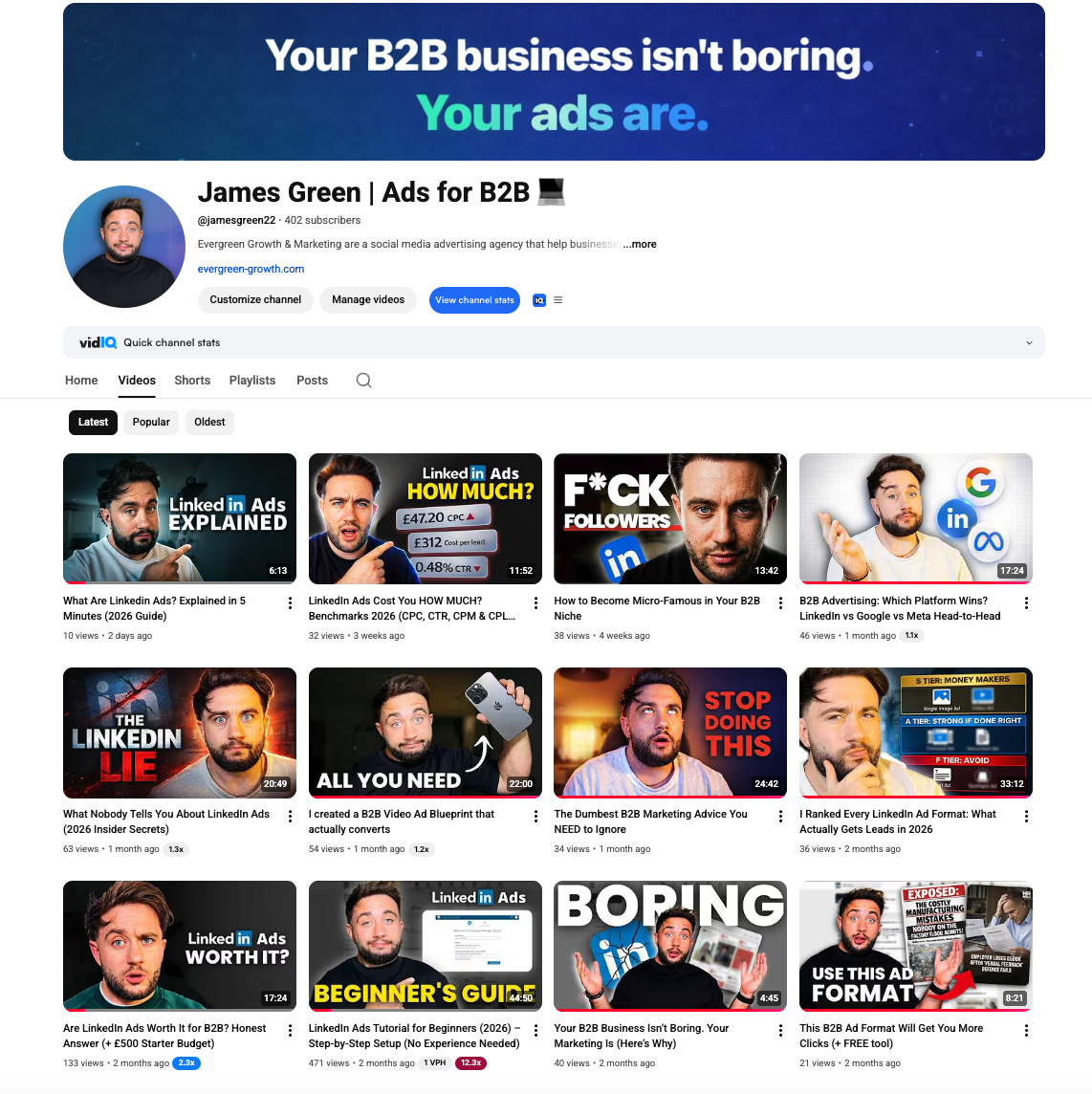
James Green | Ads for B2B
Free B2B advertising tutorials, LinkedIn Ads breakdowns, and creative strategy