This guide is for you if...
- You work for (or own) a niche, 'boring' B2B business
- You need more consistent, steady flow of leads coming in
- You're stuck on ideas for what to do next and get your sales team those leads
- You've tried content. Nobody's reading it
- You're busy. The pipeline isn't
Most B2B companies go into 2026 the same way they ended 2025. Posting content. Waiting for leads. Hoping something clicks.
Maybe you have tried paid ads and they did not work. Maybe you have not started yet because you are not sure where to begin. Maybe you are doing "all the right things" but pipeline is still flat.
This is a list of ten rules that separate the B2B companies that get predictable leads from the ones that stay stuck. Not theory. Not trends. Just what actually works when you want real results.
Implement even half of these and 2026 looks different.
Watch: The Full 10 B2B Marketing Commandments
James walks through all 10 commandments with real examples
Real Examples
Practical advice from 5+ years of B2B campaigns
Actionable Steps
Exactly what to do, not just what to think
No Fluff
Straight to what actually moves pipeline
What You'll Learn in This Video:
- ✅ Why most B2B marketing fails (and how to fix it)
- ✅ The numbers you need to know before spending on ads
- ✅ How to make LinkedIn DMs actually work
- ✅ Creative formats that stop the scroll
- ✅ Why raw video beats polished corporate content
- ✅ How to use paid ads for precision targeting
- ✅ The retargeting gap most B2B companies miss
- ✅ Proper tracking setup with GTM and GA4
- ✅ Platform defaults that burn your budget
- ✅ How to stop waiting for perfect and start shipping
No obligation • 30-minute strategy call
Stop trying to impress competitors
Build ads and content for buyers, not peers.
The problem:
Most B2B marketing fails because it is written sideways. Aimed at peers, not prospects. You can spot it instantly: jargon-heavy copy, buzzwords, "solutions" instead of outcomes, positioning that sounds impressive but says nothing. This happens because marketers unconsciously write for other marketers. Or worse, for the competition.
Why this matters for B2B:
Buyers do not care how smart your positioning sounds. They care whether you understand their problem and can fix it. Marketing that tries to look "clever" usually ends up unclear. The most common B2B marketing mistake is optimising for applause from the wrong audience. Your competitors are not going to buy from you. Your prospects might.
How to fix it:
Run your homepage and key content through these questions:
- What do you actually do? Can a stranger explain it in one sentence after 5 seconds on your homepage?
- Who is it for? Is your ideal customer immediately obvious, or could it be "anyone"?
- What problem do you solve? Not your features. The actual pain your buyer wakes up with.
- Why should they trust you? Real proof. Case studies, numbers, recognisable clients. Not "we are passionate about excellence".
- What do you want them to do next? One clear action. Not six buttons competing for attention.
If you cannot answer these clearly, neither can your buyer. And if they cannot understand it in seconds, they will leave.
The result:
Clarity increases. Conversion rates rise. Buyers see themselves in your message instead of scrolling past. If the honest answer to "would my buyer care?" is no, do not publish it.
Know your numbers
CPL, lead quality, close rate. If you do not know them, you are guessing.
The problem:
Most B2B marketers cannot answer basic questions about their funnel. What does a lead cost? What percentage become opportunities? What is the average deal size? Without these numbers, every budget discussion becomes a fight based on opinions. The CMO gets questioned. The CFO wants proof. Marketing gets cut because no one can prove it works.
Why this matters for B2B:
B2B marketing only works when it is tied to commercial reality. Without knowing cost per lead, conversion to sale, and deal value, you cannot judge performance. You cannot calculate break-even. You cannot defend budget or make a case for scaling. Opinions fill the gap where numbers are missing. And opinions do not scale.
How to fix it:
Start by knowing these numbers. Even before you spend on ads:
- Website Enquiry Conversion Rate = Enquiries that become customers ÷ Total enquiries × 100
- Average Deal Value = Total revenue ÷ Number of deals closed
- Customer Lifetime Value = Average deal value × Average number of repeat purchases
- Days to Close = Average time from first contact to signed deal
- Lead to Close Rate = Closed deals ÷ Total leads × 100
If you are running paid ads, add these:
- Cost Per Lead (CPL) = Total ad spend ÷ Number of leads
- Cost Per Acquisition (CPA) = Total ad spend ÷ Number of closed deals
- Break-even CPL = Average deal value × Lead to close rate
You do not need a fancy CRM to track this. HubSpot and Salesforce can do the heavy lifting if they are set up properly, but most are not. They just add more confusing dashboards that nobody looks at. A Google Sheet updated weekly is fine. Simple beats sophisticated if sophisticated never gets used.
The result:
Here is the surprising bit for niche B2B. When you actually run these numbers, they are often very encouraging. High deal values mean you can afford to pay more per lead than you think. A £20,000 deal that closes 10% of the time means you can spend up to £2,000 to acquire a lead and still break even. Most businesses have never done this calculation. Once you have, you can build a proper case for marketing budget and put it into something measurable like Google Ads or LinkedIn Ads. That is how you build a predictable growth engine.
Don't be scared to DM
LinkedIn DMs get a bad rap because of the worst offenders. But the proof is in the pudding.
The problem:
LinkedIn DMs have a reputation problem. Everyone has been on the receiving end of lazy, copy-paste outreach that screams "I know nothing about you but here is my pitch anyway". So most B2B companies avoid it entirely. They think it is spammy. Beneath them. A bit desperate.
Why this matters for B2B:
Here is the thing: it works. I have had to humbly back down on how wrong I was about this, both for my own agency and for clients. Consistent, personalised outreach delivers results. Email outreach is getting harder than ever. Inboxes are flooded. Deliverability is tanking. But LinkedIn messages still get read. The problem is not the channel. It is the execution. The worst offenders ruined the reputation, but that just means doing it properly makes you stand out.
How to fix it:
- Keep messages short. No essays. No life stories. Get to the point
- Personalise properly. Reference their company, their content, their situation
- The key is in the follow-up. Most replies come on message two or three, not message one
- Give them something useful: a short Loom video, a testimonial, screenshots of results for similar businesses
- Use LinkedIn's native Messaging and Conversation Ads to speed up the process (third-party automation tools are getting cracked down on)
How LinkedIn DMs compare to other outreach channels:
| Metric | Cold Email | LinkedIn DMs (manual) ✓ | LinkedIn Message Ads ✓ |
|---|---|---|---|
| Open Rate | 15-25% | 50-70% | 50-70% |
| Response Rate | 1-3% | 5-15% | 5-15% |
| Cost | Tools £50-200/mo | Free (time only) | £0.15-0.40/send |
| Scalability | High | Low (manual grind) | Medium-High |
| Deliverability | Declining ↓ | High ✓ | Guaranteed ✓ |
Data based on industry benchmarks – your results will vary based on personalisation and targeting quality.
You will have some people who are hugely offended at receiving a sales message on a business platform. Even if their own sales team is bombarding everyone with the weakest, most boring patter. Ignore them. Closed mouths do not get fed.
The result:
Consistent DM outreach becomes a genuine pipeline channel. You get responses you would never have got from posting alone. Deals start from conversations that would never have happened otherwise. It takes grind, but it works.
Want help implementing any of this?
Let's look at your current setup and find the quick wins.
Stop being boring by default
The problem:
Most B2B ads are not boring because the business is boring. They are boring because everyone defaults to what feels "safe".
Same colours. Same layouts. Same stock photos of people pretending to enjoy meetings.
After a while, buyers do not even consciously ignore these ads. Their brain filters them out automatically.
- Handshake image? Ignored.
- Generic office shot? Ignored.
- Smiling headset operator? Instantly ignored.
It is not that your message is wrong. It is that it never gets noticed long enough to matter.
Why this matters for B2B:
Attention is the real bottleneck.
You are not competing with other ads. You are competing with inboxes, Slack, meetings, and people trying to get actual work done.
If your ad blends in, it does not feel "professional". It feels invisible.
Invisible ads do not fail loudly. They quietly burn budget while everyone says, "Ads just don't work for us."
You do not need to shock people. You just need to earn a pause. That pause is where everything starts.
Three creative concepts you can steal:
You do not need clever ideas. You need formats that do not look like ads.
The result:
You stop guessing what might work. You stop blending into the background.
Your ads start looking like things people recognise from real life. They feel familiar. Honest. Relevant.
And instead of wondering why ads "don't work in B2B", you finally give them a chance to be noticed.
Use raw, unpolished video
The fastest way to build trust with buyers you have never met.
The problem:
Most B2B companies either never post video, or produce something so polished it feels like everyone else's content.
The result is the same: you fade into the background.
Your competitors look identical. Same talking heads. Same stock music. Same forgettable corporate feel. When a buyer finally gets on a call with you, they are meeting a stranger.
Why this matters for B2B:
When you show up on video consistently, your face, your voice, your personality... people start to feel like they know you.
By the time they get on a call, they have already seen you explain problems they recognise, share stories they relate to, and demonstrate you understand their world.
That is not a cold call any more. That is a warm meeting with someone who feels familiar.
Recognition builds trust. Trust shortens sales cycles. And it makes your competitors feel like strangers by comparison. The buyer feels safer choosing you because they have seen you handle similar situations before. Nobody gets sacked for choosing someone they already trust.
How to fix it:
Follow loose notes, not a word-for-word script. Record short story videos where you walk through a real customer situation. Use this structure:
The problem
What was the situation your customer was facing?
The impact
How was it affecting their business? Lost time, money, stress, missed opportunities.
The solution
How did you help them solve it with your product or service?
The result
What changed for them afterwards?
This works because viewers recognise themselves in the "before" picture. They are currently facing that same problem. And by showing you have solved it repeatedly, you are also communicating experience and reliability. People buy from companies they trust to deliver. This format proves you have done it before.
The result:
Buyers arrive at calls already feeling like they know you. Your conversion rate from first meeting improves because you are not starting from zero.
Competitors who hide behind polished, impersonal content start to feel like strangers. You become the obvious choice because you are the one they have been watching.
Prefer to watch? Here's the full tutorial
Use paid ads to reach the right buyers on purpose
Organic alone is not precise enough.
The problem:
Many B2B companies rely heavily on organic content and hope the right people find them. The problem is organic is a broadcast. You post something and the algorithm decides who sees it. That is not a strategy. That is a prayer.
Why this matters for B2B:
B2B buyers do not hang around waiting to discover you. Your total addressable market might be a few thousand people. You need to reach specific job roles at specific companies at the right time in their buying cycle. Organic cannot do that. Paid is distribution with precision. Job roles, company sizes, industries, intent signals, timing. You choose who sees your message.
How to fix it:
- Define your ICP with specificity: job titles, seniorities, company sizes, industries
- Layer LinkedIn targeting to narrow to your exact audience
- Upload customer lists to create lookalike audiences of your best clients
- Use intent signals and engagement data to prioritise buyers in-market
The result:
Predictable pipeline. Every pound goes to people who could actually buy. Organic builds authority over time, but paid is how you get in front of the right people on your terms, this quarter.
Halfway there. Ready to talk strategy?
If this is resonating, let's see how it applies to your business specifically.
Start retargeting
The single biggest quick win most B2B companies will never use.
The problem:
This genuinely baffles me. Retargeting is everywhere in B2C. Every online shop does it. Buy a pair of shoes and they follow you around the internet for weeks. Everyone knows it works.
But in B2B? Almost nobody does it. Most niche B2B companies have never even considered it. Some do not know it is possible.
Think about that for a second. Someone visits your specialist industrial equipment website. They did not get there by accident. They found you through Google, clicked an ad, followed a LinkedIn post, or got forwarded your link by a colleague. They are interested. They are researching. They are exactly the person you want to talk to.
And then you let them leave and never see them again.
Why this matters for B2B:
Nobody visits a niche B2B website for a laugh. If someone lands on your industrial parts manufacturer site, your specialist software page, your engineering consultancy... they have a reason. They are in-market or getting there.
But B2B buyers rarely convert on first touch. Sales cycles run three to nine months. People get distracted, priorities shift, budgets get frozen, that urgent project lands on their desk. If you are not staying visible throughout that process, you are losing to whoever is.
This is the lowest-hanging fruit in B2B marketing. Even with tiny website traffic. Especially with tiny website traffic, because every visitor matters more.
How to fix it:
- Install your tracking pixels (LinkedIn, Meta, Google). This takes 30 minutes
- Build website visitor audiences segmented by intent (pricing page vs blog)
- Create video viewer audiences (25%, 50%, 75% watched)
- Segment by recency: 7 days, 30 days, 90 days
- Serve different messages to different intent levels
The result:
You stay visible through the entire buying cycle without being intrusive. Cold traffic becomes warm traffic. Warm traffic becomes pipeline. Your cost per acquisition drops because you are re-engaging people who already know you.
Stop letting your hardest-won traffic vanish into thin air. They found you. Do not lose them now.
Fix your tracking properly
Google Tag Manager is how you install any tracking pixel, once.
The problem:
Most B2B companies have broken or incomplete tracking. The LinkedIn pixel is on the homepage but not the pricing page. Conversion events are set up incorrectly or not at all. Form submissions are not being tracked. The result is you are spending money every month with no idea what is actually working.
Why this matters for B2B:
In B2B, leads are fewer, sales cycles are longer, and deals are higher value. That makes guessing lethal. Without proper tracking, you cannot retarget your highest-value visitors. You cannot tell which campaigns drove pipeline and which just burned budget. You cannot optimise because you have no data to optimise against. Most B2B teams do not have a performance problem. They have a visibility problem.
Why Google Tag Manager Changes Everything
GTM is a container you install once on your website. After that, you add LinkedIn, Meta, Google Ads, TikTok, and any other tracking pixel from the GTM interface, without touching your website code again.
- 1.One installation, unlimited pixels
Install GTM once. Add or remove any tracking pixel without developer help.
- 2.Consistent event tracking
Set up a form submission trigger once. Fire it to GA4, LinkedIn, and Meta simultaneously.
- 3.Preview before publishing
GTM's preview mode lets you test everything works before it goes live. No more broken pixels.
GTM Setup Steps
- 1.Create a GTM account and container
Go to tagmanager.google.com. Create an account, then a container for your website (Web type).
- 2.Install the GTM code
Add the GTM code snippets to every page, one in the head, one after the body tag. Most website platforms have a dedicated GTM field.
- 3.Add your GA4 Configuration tag
In GTM, create a new tag → Google Analytics: GA4 Configuration. Add your Measurement ID (starts with G-). Set trigger to "All Pages".
- 4.Add platform pixels
Add LinkedIn Insight Tag, Meta Pixel, Google Ads tag, each as a separate tag, all firing on "All Pages".
- 5.Create conversion triggers
Set up triggers for form submissions, button clicks, and thank-you page views. Attach these triggers to conversion tags for each platform.
- 6.Preview, test, publish
Use GTM Preview mode to verify everything fires correctly. Then hit Publish.
AI Setup Assistant Prompt
Copy this prompt and paste it into ChatGPT, Claude, or any AI assistant. It will ask you questions about your setup and generate step-by-step GTM instructions tailored to your exact situation.
I need help setting up Google Tag Manager and conversion tracking for my B2B website.

Please ask me the following questions first, one at a time:

1. What platform is my website built on? (WordPress, Squarespace, Webflow, Wix, Shopify, HubSpot CMS, custom-coded, or other)

2. Do I already have Google Tag Manager installed on my website? (yes / no / not sure)

3. Do I already have Google Analytics 4 set up? (yes / no / not sure)

4. What CRM or form tool do I use for lead capture? (HubSpot, Salesforce, Typeform, Gravity Forms, Contact Form 7, native website forms, Calendly, or other)

5. What specific actions do I want to track as conversions? (Examples: contact form submissions, demo bookings, pricing page views, resource downloads, newsletter signups)

6. Which advertising platforms do I plan to run ads on? (LinkedIn Ads, Meta/Facebook Ads, Google Ads, Microsoft Ads, TikTok Ads, or other)

Based on my answers, please provide:

1. A step-by-step GTM installation guide specific to my website platform
2. Instructions for setting up GA4 through GTM (if not already done)
3. Exactly how to create the triggers I need for my form tool and conversion actions
4. Tag setup instructions for each ad platform I mentioned
5. How to verify everything is working correctly using GTM Preview mode and browser extensions

For visual walkthroughs and screenshots, reference this guide: https://evergreen-growth.com/articles/tracking-pixels-setup-guide

Keep instructions clear and actionable. Assume I am not a developer but can follow step-by-step instructions.
How to fix it:
- Install Google Tag Manager on every page of your website
- Add all your tracking pixels (GA4, LinkedIn, Meta, etc.) through GTM
- Set up conversion events for form submissions, demo bookings, and key page views
- Verify everything fires correctly using GTM Preview mode
- Connect your ad platforms to your CRM so you can see which campaigns drive actual pipeline
The result:
Once tracking is fixed, you can finally see what is working. You can build retargeting audiences of your warmest traffic. You can stop funding guesswork and start scaling winners.
Do not let platform defaults burn your budget
Set things up properly before spending.
The problem:
Ad platforms are designed to make spending easy, not effective. Defaults are set to maximise their revenue, not your results. LinkedIn wants you to reach as many people as possible. Meta wants your ads to run on every placement. Google wants automatic everything. These defaults optimise for volume, not quality.
Why this matters for B2B:
In B2B, bad defaults mean junk leads, wasted spend, and false conclusions about whether ads "work". If LinkedIn is showing your ads outside the platform or to people outside your targeting, you are paying for reach that cannot convert. Setup quality matters more than clever creative.
LinkedIn Settings to Turn Off Immediately:
- 1.Audience Network extends your ads to third-party sites and apps outside LinkedIn. The placements are often low quality.
- 2.Audience Expansion lets LinkedIn show your ads to people outside your targeting. Which defeats the entire purpose of precise B2B targeting.
How to fix it:
- Audit every campaign setting before spending a penny
- Turn off Audience Network and Audience Expansion on LinkedIn
- Disable automatic placements on Meta and select manually
- Set cost controls and bid caps to protect budget
The result:
Lead quality improves immediately. Budget goes to your actual target audience. You stop paying for traffic that was never going to convert.
Nearly there. Need help with the technical bits?
Tracking, pixels, platform setup... we can sort it for you.
Stop waiting for perfect
Ship, learn, adjust.
The problem:
B2B teams often hide behind planning because mistakes feel expensive. The landing page needs one more review. The creative needs sign-off. The messaging is not quite right. So campaigns stay in drafts, launches get delayed, and quarters pass without learning anything. Meanwhile, competitors are in market testing and iterating.
Why this matters for B2B:
Slow decisions cost more than imperfect execution. Feedback beats theory. Markets move, competitors test, and buyers decide whether you show up or not. Progress comes from iteration, not readiness. A mediocre campaign that actually runs will teach you more than a perfect campaign that never launches.
How to fix it:
- Set a non-negotiable launch date. Work backwards from there
- Accept "good enough" and ship. You can always iterate
- Define learning goals before launch. What questions will this answer?
- Ship something every week. Momentum compounds
The result:
You learn faster than everyone else. Momentum builds. Confidence replaces paralysis. The companies that win are the ones that test quickly, learn quickly, and adjust. Perfect is the enemy of profitable.
Prefer to watch? Here's the full tutorial
This is your year
You have just read ten things that separate the B2B companies that grow from the ones that stay stuck.
Not theory. Not fluff. Things that actually move pipeline when you do them properly.
Pick one. Start this week. Not next quarter. This week.
Maybe it is finally fixing your tracking so you know what is working. Maybe it is sending those DMs you have been putting off. Maybe it is recording that first unpolished video that builds trust faster than any brochure ever could.
The gap between companies that grow and companies that stay stuck is not knowledge. It is action. You have the knowledge now.
2026 can be the year your pipeline finally becomes predictable. The year you stop guessing and start scaling. The year you look back and say, "That is when it clicked."
But only if you move.
Need help making this happen?
If you want someone to actually implement this with you, fix your tracking, build your audiences, create ads that convert, and turn your ad spend into predictable pipeline... let's talk.
30 minutes. No pitch deck. Just a look at where you are now and what needs to happen next.
Free. No obligation. Genuinely useful even if we never work together.
Watch Free B2B Ad Tutorials
Campaign breakdowns, creative strategy, and LinkedIn Ads walkthroughs — straight from a practitioner, not a guru.
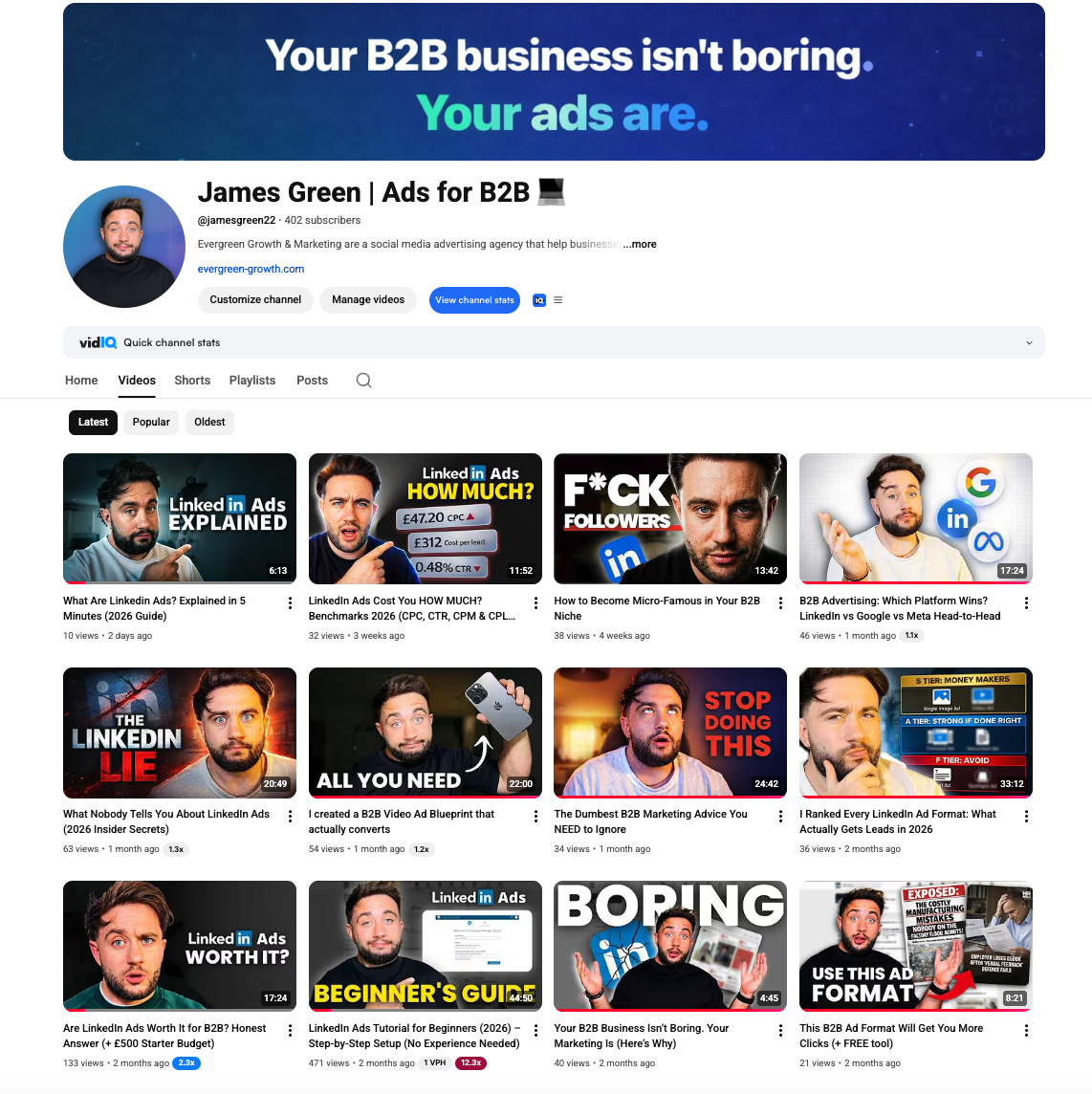
James Green | Ads for B2B
Free B2B advertising tutorials, LinkedIn Ads breakdowns, and creative strategy
Related Tools & Resources
LinkedIn Ads Budget Calculator
Estimate your CPL, expected leads, and break-even deal size
LinkedIn Ads Benchmarks UK 2026
Complete CPC, CPM, CPL data by industry with expert commentary
Tracking Pixels Setup Guide [2026]
Complete guide to LinkedIn Insight Tag, Meta Pixel, and GTM setup
LinkedIn Insight Tag Setup
Step-by-step LinkedIn pixel installation for retargeting