The problem
Three days out of 365
Most exhibitors spend months planning a show and a few days following it up. Here's what the year looks like when the show is the only time buyers see you.
A year of visibility with a target account
Top bar: you exist for three days. Bottom bar: the same show, but the companies you care about see you every week. When one of them starts looking for a supplier in month seven, you're the name they already know.
And B2B deals are rarely decided by the person who stopped at your stand. They report back to four or five colleagues who never met you. Unless something reaches those colleagues, you start the buying process as a stranger.
Before the event
Arrive already known
The goal isn't to reach every attendee. It's to make the small group of companies who could genuinely buy recognise your name, your people and the problem you solve before they walk past your stand.
Step 1: Build the list from companies you can name
Stack these four groups into one spreadsheet of company names. This becomes your LinkedIn audience.
Current customers
Protect them. Competitors are at the same show.
Open and lapsed opportunities
The deals that went quiet. The show is your excuse to reappear.
Dream accounts
The 50 to 200 companies you'd most like to win.
Filtered exhibitor and visitor companies
The public list, minus everyone who can't buy from you.
Not sure who belongs on it? The free account list builder gives you 50 named companies and the search strings to find more.
Step 2: Add the people who actually decide
On LinkedIn you can narrow each company down by job title. So instead of reaching 400 staff at a food manufacturer, you reach the handful who sign off a purchase like yours.
Two settings that matter
LinkedIn needs at least 300 matched members before an ad will run, so a list of 20 companies with narrow titles may be too small. Add more companies or more relevant titles rather than broadening. And switch off Audience Expansion, or LinkedIn will quietly show your ads to people outside your list.
Go deeper: How to upload a company list into LinkedIn Campaign Manager
Step 3: Give them a reason to find you
What most exhibitors post
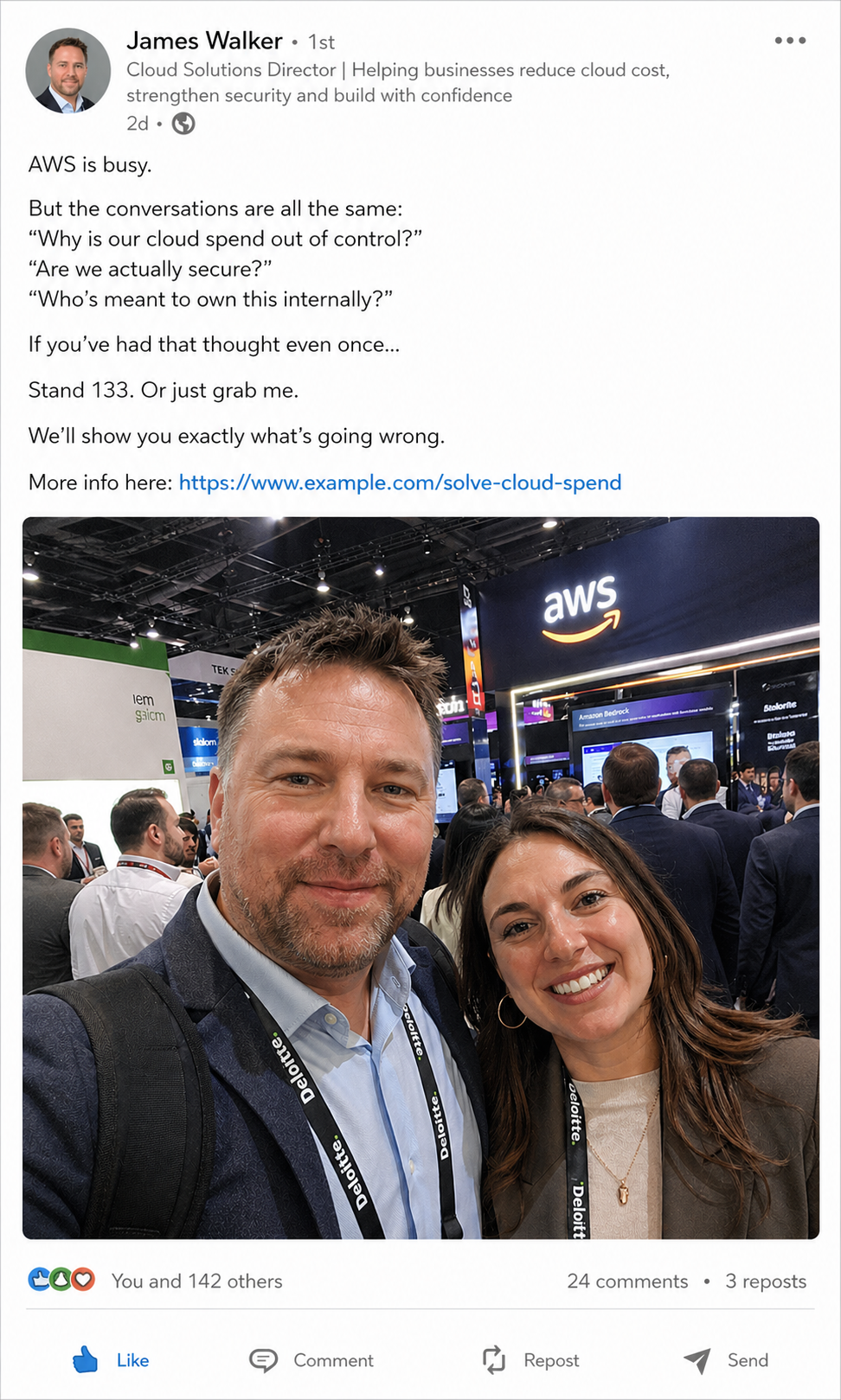
"We're excited to be exhibiting at Packaging Innovations 2026. Come and see us on stand B47!"
What gets noticed
"Every year at this show someone asks me why their changeovers take 40 minutes. Bring your line spec to B47 and I'll show you where the time goes. Takes ten minutes."
Post it from the founder, engineer or consultant who'll be on the stand. Then put budget behind the post as a Thought Leader Ad so it reaches your list. It looks like a normal post in the feed, from a real person.
If the show is next week
Do three things. Skip everything else.
- 1Upload your customers, open opportunities and 50 dream accounts as one company list.
- 2Write one post from the person going: the problem you'll be talking about and a reason to stop by.
- 3Boost it as a Thought Leader Ad to that list, with decision-maker job titles, from now until the last day of the show.
During the event
Capture what buyers say, not what your brochure says
For three days your target market is walking up and telling you, in their own words, what they worry about. Almost every exhibitor lets that disappear. Capture four things and you have months of adverts.
The questions buyers ask
Write down the exact words. "Does it work with our old line?" is a better advert headline than anything your agency will write.
You need: A notes app, one list per day
Short vox pops
One question your market genuinely argues about. Ten to twenty answers. Get written or recorded permission before you publish.
You need: A phone and a clip-on mic
The bit people stop to look at
Film the 30 seconds of demo where visitors lean in. Not a tour of the stand. Not the logo wall.
You need: Phone on a small tripod
Founder observations
What surprised you, what everyone disagreed about, what nobody is talking about. Posted from a real person, not the company page.
You need: Two minutes at the end of each day
A daily routine that takes 20 minutes
Keep the audience fixed to your company list. The point isn't viral reach. It's that the people who matter see your team in the middle of the conversation while they're at the same show.
Go deeper: The week-by-week exhibitor playbook for LinkedIn Ads
After the event
The 12-month follow-up
The usual follow-up is one email to every badge scan. A few reply. The rest go quiet, and a year later you pay to stand in the same hall and meet them again. Here's the alternative.
First 48 hours
Send what you promised, person by person. Group every contact, note and scan by company. Upload scans as a LinkedIn contact list.
Weeks 1 to 4
Show the whole buying committee at each company who you are: the founder's posts, the vox pops, the demo. Recognition, not a pitch.
Months 2 to 6
Move to proof. Customer stories, how it works, the awkward questions answered, an advertorial on the problem you solve.
Months 6 to 12
Stay present while budgets get set. Retarget anyone who watched or visited. Direct messages to the most engaged accounts. Book the next show.
Tell sales which companies are warming up
LinkedIn's Company Engagement report shows which companies on your list are seeing and interacting with your adverts. Combine that with who you met and who's visiting your website, and sales know who to call first.
| What you see | Priority | What to do |
|---|---|---|
| Met at the stand and a colleague engaged with an advert | Hot | Sales call this week |
| Several people from one company watching video or visiting the site | Warm | Personal follow-up with something useful |
| Engaging with adverts but never met you | Warming | Keep in the campaign, invite to a demo |
| Badge scan with no activity since | Cold | Stay in the audience, try a new angle |
Engagement is a reason to get in touch, not proof someone wants to buy. Treat it as context for a useful conversation.
Just got back from a show?
Trade show follow-up with LinkedIn Ads: the full 12-month plan
The four audiences to build, six advert styles with examples, what it costs and how a machinery manufacturer got 15× return from the same approach.
Read the guideContent
Two event assets people actually remember
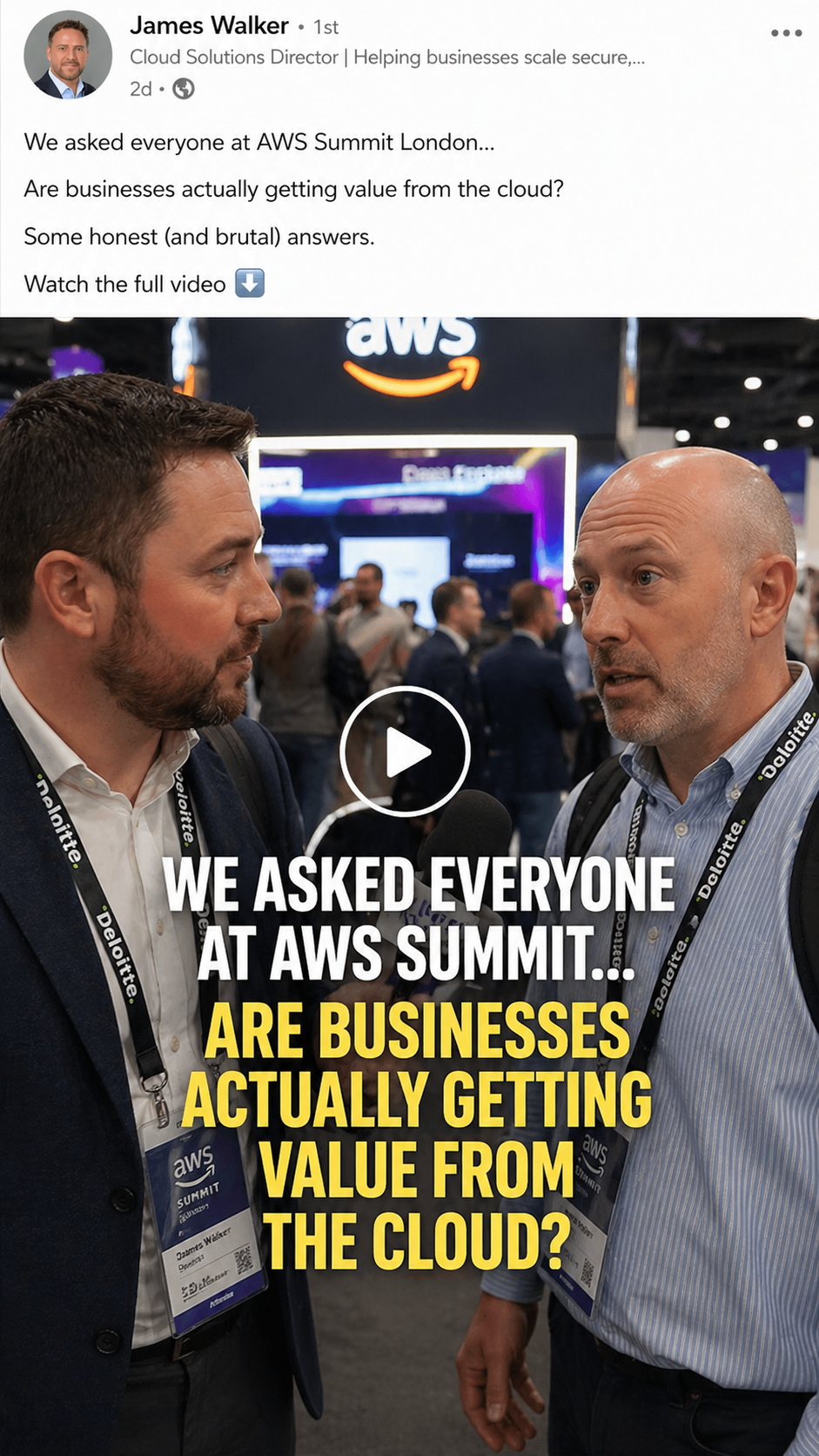
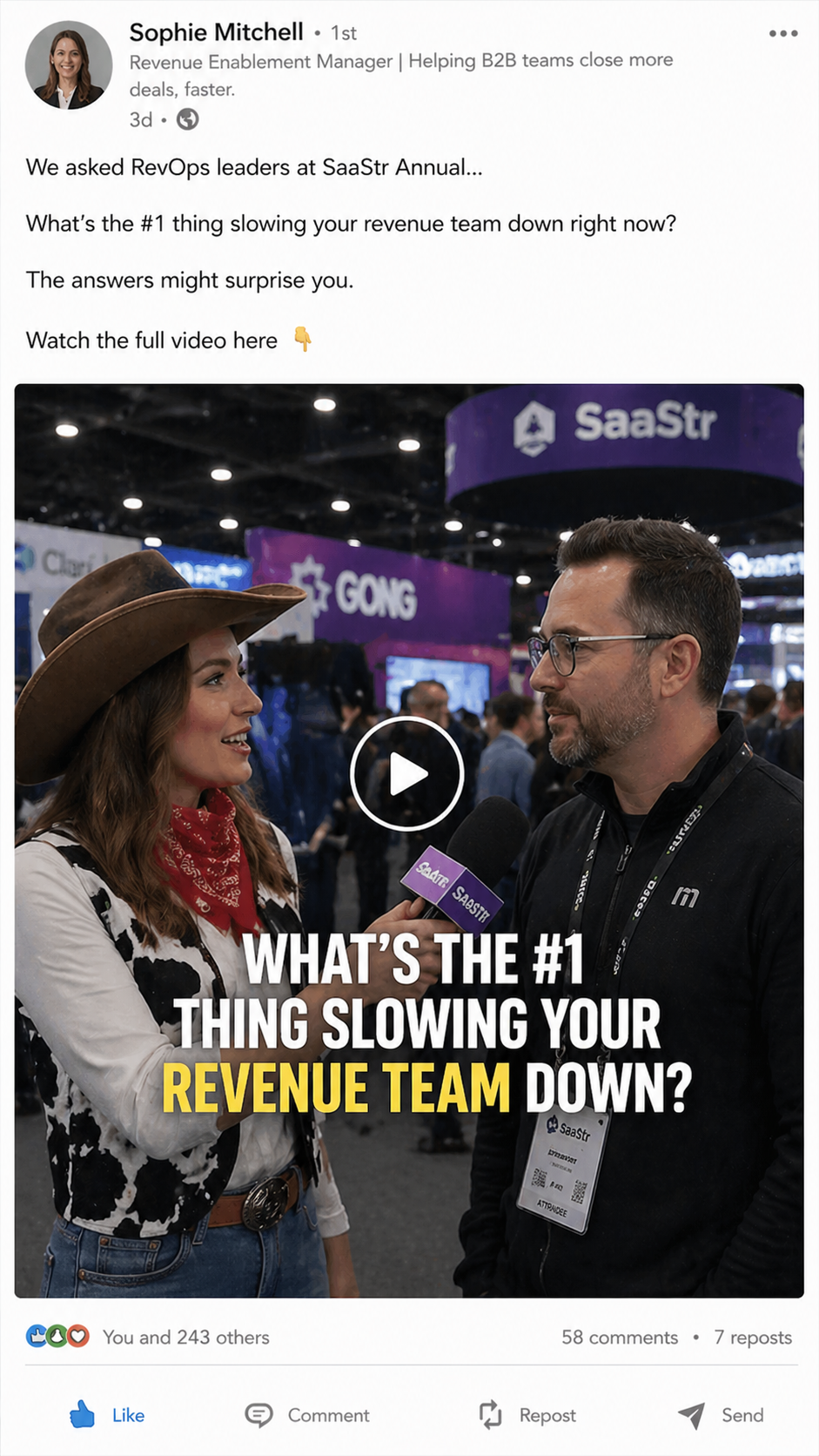
Vox pops built on one question
Ask one question your market genuinely argues about. Keep the clips short, caption them and let buyers hear their peers say it. People trust the person next to them in the hall far more than they trust you.
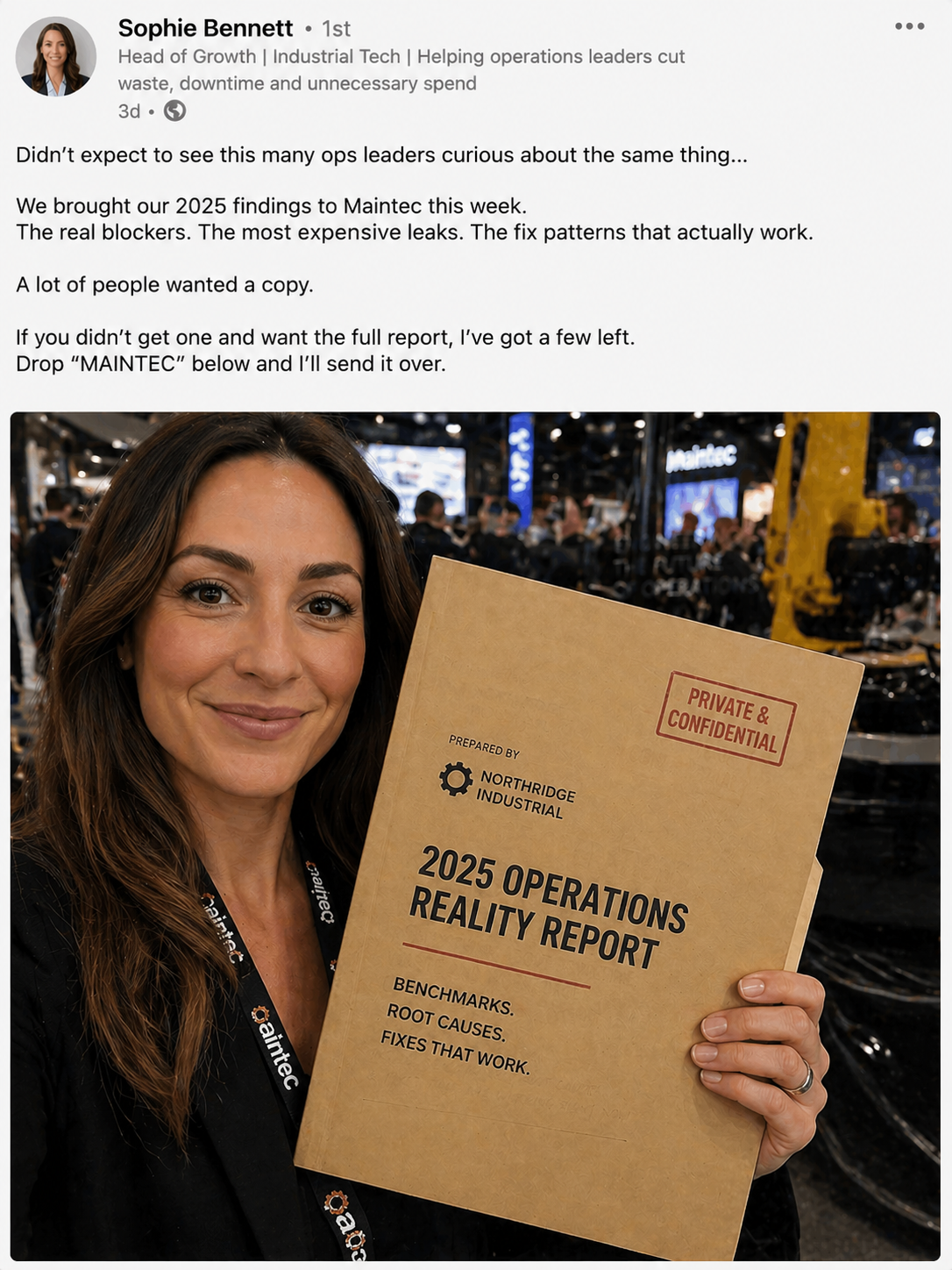
A leave-behind worth keeping
Swap the glossy brochure for something that helps: a benchmark, a checklist, a short report on the problem they came to solve. For your top ten accounts, make a version with their name on it.
Didn't film anything? You can still make most of this afterwards. The founder can talk to camera about what buyers asked, and the leave-behind works just as well sent by post. Free tools to help: the video script generator and the anti-ad builder.
Money
What to spend
There's no honest universal number, but there is a sensible way to think about it.
Start with the event cost
Add up the stand, travel, hotels, staff time and print. That's what you've already invested in these companies.
Spread a slice across the year
A small monthly LinkedIn budget aimed at a precise list often costs far less than the stand itself.
Check the floor
LinkedIn's minimum is around £10 a day per campaign. Small lists spend less than you'd expect.
Use the free Trade Show ROI Calculator to plug in your own event costs and results. It won't promise a made-up multiplier. It shows what the event is costing you per conversation and what a year of follow-up would add. You can also check realistic spend with the LinkedIn budget calculator.
Avoid these
Seven mistakes exhibitors make with LinkedIn
"Visit us at stand 47" as the whole advert
Nobody books a flight because of a stand number. Give them a reason: a question answered, a demo, a person worth meeting.
Targeting everyone at the show
Most attendees can't buy from you. Build the audience from named companies and the job titles that decide.
Leaving LinkedIn Audience Expansion switched on
It lets LinkedIn show your ads outside your list. Switch it off for every event campaign.
One follow-up email, then silence
The person you met reports back to four or five colleagues who never saw you. Reach them too.
Running the event recap for months
"Great to see you at the show" is stale after three weeks. Move on to proof and objections.
Sending ad clicks to the homepage
Send them to a page that carries on the same conversation and makes booking easy.
Judging it on badge scans
Scans measure footfall. Judge it on meetings, opportunities and deals from target accounts.
Proof
What to measure
Badge scans flatter a bad event. For niche B2B, judge it on the companies and buying groups behind the activity.
| Measure | The question it answers | Where to find it |
|---|---|---|
| Target accounts reached | Were the right companies seeing you at all? | LinkedIn Company Engagement report |
| Buying committee coverage | Are you reaching more than the one person you met? | LinkedIn demographics by job title |
| Qualified conversations | Did the event and adverts produce real conversations? | Your CRM |
| Target account site visits | Are companies on your list coming back to look? | Website analytics, LinkedIn Insight Tag |
| Opportunities and pipeline | Did new or revived deals appear from event accounts? | Your CRM |
| Won revenue | Kept separate from influenced pipeline. Takes a full sales cycle. | Your CRM and finance |
Go deeper: How to prove LinkedIn Ads are influencing pipeline in your CRM
B2B event marketing FAQs
Can LinkedIn advertising still help if the event is next week?
Yes. Use one strong personal post, a tightly defined company and job-title audience and a clear reason to speak at the event. Don't try to build a complicated funnel in five days.
What if the event has already finished?
Start with the companies and people you met, the pages they visited and any content you captured. If you captured nothing, you can still film the founder talking about what buyers asked. Read the guide to LinkedIn Ads after a trade show for the full 12-month plan.
Should we target every attendee?
No. Most niche B2B firms should target the companies and buying roles that can genuinely buy. Precision matters more than the organiser's headline attendance figure.
How long should post-event advertising run?
For a long B2B buying cycle, think in months, not weeks. Keep it running while the audience is still worth reaching and change the message as the event becomes less relevant.
Should LinkedIn Audience Expansion be enabled?
No. For named-account event campaigns it weakens the point of the list by allowing delivery beyond the audience you chose.
What should the first pre-event advert say?
Lead with a useful opinion, demonstration or buyer problem connected to the event. Treat the stand number as supporting information, not the whole message.
Do we need professional event video?
No. Clear sound, a steady frame and a useful point matter more than production. A candid clip from the right expert is often more believable than a polished montage.
Can we use the exhibitor list for targeting?
Use the public list as a research starting point, remove companies outside your market and add the buying roles you need. Follow the organiser's terms and data rules.
What is a qualified event conversation?
Define it before the event. Normally: a relevant company, a plausible buyer, a real problem and an agreed reason to keep talking.
How should sales use LinkedIn engagement after the event?
As context, not proof that someone wants to buy. Prioritise accounts showing several signals and approach them with the useful follow-up you promised.
What's the minimum LinkedIn budget for an event campaign?
LinkedIn's minimum is around £10 a day per campaign. For a small company list, a few hundred pounds a month can keep you visible. Use the Trade Show Amplification Planner to work out a figure from your own event costs.
What if our LinkedIn audience is very small?
LinkedIn needs at least 300 matched members to run an ad. Build from named companies, add every relevant job title and combine related groups. Don't pad it with irrelevant companies.
Can event content be reused later?
Yes, if it still answers a buyer question. Remove dated references and turn the best material into posts, clips, guides, sales follow-up and retargeting adverts.
How do we connect the event to revenue?
Record the company, people, conversation and next step in the CRM, then track opportunities and customers over the normal sales cycle. Keep influenced pipeline separate from won revenue.
Can Evergreen run this for us?
Yes. We build the company list and audiences, make the adverts with you, run the campaigns and report which accounts are warming up. Book a call with your next or last event in mind.